 Issue 117 (April 1999)
by Dan Sweeney
Issue 117 (April 1999)
by Dan Sweeney
Specialty audio has two classes of components worthy of consideration - those that define the absolute limits of performance within a product category and those that represent superior value for a given price. The Alternate Audio PS-40 is one of the latter.
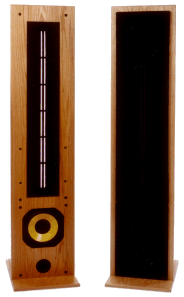
Alternate Audio is a small manufacturing firm in Orem, Utah, that grew out of a retail establishment. In addition to loudspeakers, the company manufacturers a preamp and single-ended solid-state power amplifiers. The PS-40, currently the company's only loudspeaker, is a hybrid design using a planar dynamic element from 300Hz up coupled to a 10-inch cone. The planar is operated as a line source dipole, while the cone, which occupies a vented enclosure, is, of course, a point-source omni.
The basic design concept is not new. Strathearn of Northern Ireland developed this type of planar dynamic in the mid-Seventies and sold it as a component driver to a number of manufacturers, of whom Jack Caldwell was perhaps the most committed. Caldwell produced speakers rather similar to the PS-40 during the early Eighties, and other derivatives of the basic design were developed by VMPS, Gold Ribbon Concepts, Carver Corporation, Genesis, NewForm Research, and Bohlender-Graebner.
The species of wide-range driver element upon which all of these speakers is based is a stretched film type bearing a foil conductor on either side of the diaphragm, which itself is situated within an elongated magnetic structure with gaps both front and back. Unlike the related Magnepan type planar dynamic, these drivers are push-pull in operation, and have rather limited areas of driven surface. They're really gigantic tweeters, and do not permit full-range operation, though the Bohlender-Graebner can be operated down to about 100Hz.
The strength of this type of driver is its bandwidth - approximately eight octaves at best, its low mass, and the largely resistive load it presents to the amplifier. Its liabilities are a series of high Q resonances arising from both the stiffness of the diaphragm (under tension) and the resonant cavities formed by the magnet assembly; the generally low electrical efficiency of the driver; and the extreme difficulty in matching the device to a mass-loaded piston, with its markedly different mechanical and acoustical properties. Add to these the problems in achieving tight tolerances during the manufacturing process and the high cost of materials, and you can understand why such drivers have remained oddities throughout the more than 20 years of their existence.
I once owned a similar system, the Gold Ribbon Concepts 3.0 hybrid. I think I know the strengths and weaknesses of the type, and I value its strengths. (I should add that I was employed at one time by Gold Ribbon Concepts as a technical writer, and so I am very familiar with the construction and operation of this kind of loudspeaker.) Dan Patten, designer of the PS-40, a former Gold Ribbons dealer, has spent more than ten years experimenting with these drivers.
Once Over
The PS-40 stands nearly six feet tall. The 40-inch planar contributes most of the length. A 10-inch Focal Kevlar cone resides below. The system is dressed in an oil finished oak veneer. Cabinet work is okay, but not on the level of German Physiks or Monitor Audio.
The ribbon panels and woofer boxes are shipped in separate containers and must be assembled with Allen screws. The owner's manual advises that assembly is a two-person job, and indeed it is. It took my wife and me about 20 (relatively hassle-free) minutes to put them together. Speaking of wives, I'm always hesitant to discuss the so-called "wife acceptance factor," since the term is so prejudicial, but my wife thought the PS-40s aesthetically pleasing and good sounding. I am the one who found them too dominating visually.
The quasi-ribbon is mounted on a flat baffle and secured by a massive metal mounting plate. In appearance it is very similar to the Carver and the older Gold Ribbon design. The driver appears to be precisely fabricated and tightened with just the slightest wrinkling evident near the ends of the diaphragm.
The PS-40 uses a first-order passive crossover; the system permits true line-level active bi-amping. Since I lack a high-quality line-level crossover set to the correct filter values, I did not test this option. Incidentally, the system has the best binding posts I've ever seen. They appear to be custom-made.
As a concession to cost, no doubt, neither the flat open baffle above nor the box below are at all well damped. Both respond ro knuckle raps with hollow, resonant thwacks. By contrast, my Gold Ribbons system had 250 pound cabinets cross-braced every two inches and extensionally damped with sand-loaded resin and packed with long-haired wool. Bur then my cabinet consumed some $500 in voidless Finnish birch and cost two grand. By normal margins, the assembled system would have cost close to 20K. (It was essentially a custom-kit project; total parts and labor amounted to roughly 6K.)
Cabinets are typically the most expensive part of speakers and reinforcing the PS-40s' flimsy panels would have raised the cost dramatically. Patten told me that the company has considered a more substantial enclosure, but was committed to meeting a pre-determined price. He and his associates believe that the speaker in its present configuration represents the best cost/benefit ratio.
Listening Closely
Just before receiving the PS-40s, I gave away my Gold Ribbons, and so I had to compare the two from memory - never an entirely reliable process. My experience with the Gold spanned a decade, though, and I knew it intimately.
In many respects the PS-40 is a better loudspeaker system, notwithstanding its compromised cabinet construction and much lower price. The Gold suffered from a certain steeliness that militated against extended listening sessions or easy surrender to the sensual surfaces of music. The PS-40 appears to be better balanced, though instrument measurements do not entirely bear that out.
As with most dipolar planars, the PS-40 casts a great panoramic soundstage, an illusion that is surely facilitated by the return of the driver's back-wave from the front wall of the listening space. My listening room is fairly heavily damped across the front wall, with tube traps choking the corner boundaries across the floor, ceiling, and wall boundaries, and a 2-inch thick fiberglass wall panel covering roughly 40 square feet of plaster, so a goodly portion of the higher frequencies are lost to fibrous absorption. Still, enough of the midrange comes back to engorge the vital warmth and presence regions and to create a quite convincing illusion of a deep proscenium stage behind the performers whether or not that's warranted. On full orchestra recordings, such as Harfkonzert C-dur, Boieldieu [Deutsche Grammophon heavy vinyl reissue, SLPM 0138118], as well as largish chamber ensemble recordings such as Barock by the Drottingholms Barockensemble and Andrew Dalton [Proprius, Prop 7761] and Two Centuries of Trumpet performed by Don Smithers with the Clarion Consort [Philips 6769056], this works to excellent advantage. Not only is a credible impression of natural hall sound created, but a stable disposition of instrumental forces about the performance space is provided.
On close-up jazz recordings, such as Terry Waldo and the Gotham City Band [Stomp Off, S.O.S. 1120], the contribution of the front wall is perhaps less appropriate. On at least one studio choral pop recording, the presentation proved eminently successful, however. Reproducing the new Alto edition of the Roches' eponymous first album [a Robert Fripp "audio verite" nugget originally issued on Warner, 7599 27390-1], the three New Jersey singers sound much as in life: alternately raucous and saccharine, their agile harmonizing a sibling rivalry of distinct tonalities. The punctuation of acoustic guitar licks accompanying the caterwauling comes through with uncommon clarity, with each string announcing itself distinctly.
Planar speakers are characteristically excursion limited; my Golds would define those limits with a waspish buzz. The PS-40 never buzzed, indeed never evinced distress in any manner when digesting large signals. Particularly at high frequencies, the system was unrestricted in its dynamic capabilities. Dick Sudhalter's trumpet blasts were eerily close to the mark on Get Out und Get Under the Moon, with Connie Jones [Stomp Off, S.O.S. 1207]. As was Don Smithers' very different Baroque trumpeting on Two Centuries of Trumpet (Smithers is the supreme exponent of the clarino trumpet and the first to revive successfully its lost playing techniques). Incidentally, the system achieved satisfactory sound pressure levels with my 30 watt Pathos Twin Towers hybrid, and utterly untrammeled dynamics with my 280-watt Wolcott Audio Presence all-tube monoblocks.
But as with most such hybrid speaker systems, the wild frontier encompassing the crossover region from the woofer to the ribbon is a place where amplitude values tend to get addled a bit. At 300Hz, the planar is approaching the lower limits of its operating range and is severely excursion limited relative to the demands of the music while the woofer is in the Frequency range of its maximum output. The 6dB crossover provides considerable overlap, but the drivers make imperfect harness mates. On the Super Analogue Disk, Super Percussion [King Records, SSY 19], the snare and tom toms seem a trifle recessive, while the bass drum, confined largely to the woofer, seems overly prominent and slightly laggard.
Generally the perceived transient response of the system in all but the low bass is excellent with the low-mass diaphragm nipping in and out of arpeggios with aplomb. But the ribbon doesn't stop as quickly as it starts, and the numbers diverge from the listening impressions.
Late in my evaluation, I decided to run a few tests with my SysID automated measuring system. As with many planar systems, measured performance is puzzling. The direct output of the panels is measurably elevated in the region from 4 to 5kHz at both one- and two-meter microphone positions. The peak is considerable - over 5dB - and probably represents a channel resonance caused by the magnet structure. Most manufacturers of planar dynamic systems attempt to notch this anomaly out with trap filters, but if this is the case with Alternate Audio, the filters are not very effective. Nevertheless, the effect of this blemish was not so apparent in my listening room, what with the backwash of treble-deficient reflections from the highly damped front section. I suspect, however, that in a more reflective environment, the PS-40 would tend to sound aggressive.
As with some of the Magneplanars I have measured, the PS-40s ring, though not to the same degree.' The initial spike of the impulse reaches to the stars, evincing an instantaneous rise time and abundant dynamic capabilities, but the excitation dies rather slowly. John Atkinson of Stereophile, who has measured many more planars than I, believes that such "chaotic" behavior is rather typical of the breed, and perhaps he's right.
One thing I observed in the time domain measurements, something I have never seen in another speaker, is the way that it settles at almost a perfectly uniform rate across the spectrum. Most speakers, when subjected to time/energy measurements or "waterfalls" as they're known in the trade - show much more rapid decay at some frequencies than at others, the livelier regions of the spectrum signifying resonances. The PS-40 is different in that regard, markedly different. A uniform decay rate across the spectrum is normally considered highly desirable, but one would also like that decay to be rapid, which it isn't with this system. Perhaps the time-domain behavior of the system would be measurably better with a less resonant baffle.
Last Words
The PS-40s are immediately engaging loudspeakers with all of the planar virtues along with a remarkable capacity to render dynamic contrasts. Directly competitive with the somewhat more expensive Martin-Logan Request or Final 0.4 hybrid electrostatic systems, the PS-40s appear to have a similar sonic appeal while offering fairly high efficiency and an easy load for any amplifier. A direct comparison among these systems would be instructive. I found the PS-40 to provide consistently enjoyable listening and an overall impression of musicality that always enabled me to listen through its shortcomings. I would, however, like to experience the full potential of this driver in a more highly engineered enclosure.1. Both the Magneplanar 1.5 that I measured and, to a lesser extent, the PS-40 exhibit several milliseconds of fairly high-amplitude ringing after being shocked by a pulse. In other words, a succession of saw-toothed spikes follows the initial spike representing the pulse test signal when the speaker output is measured on the Ariel SyslD automated loudspeaker testing system. Impulse response in both is inferior to that of a number of conventional cones and domes speakers I have measured. What's going on here? The Magneplanar diaphragm is a stretched membrane damped only by the air load upon it. The PS-40 diaphragm is edge damped by a succession of elastomeric pads adhering to the back of the magnet assembly. In contrast, the Infinity Epsilon, a planar magnetic design with excellent impulse response, used a constrained layer of damping material within the diaphragm itself sandwiched between two micro-thin layers of Kapton. Incidentally, the Epsilon, never really in full production, was one of the best speaker systems ever made, but unfortunately marked Infinity's swan song in the high-performance market.
Why does the relatively poorly damped PS-40 yet sound quick and articulate? I don't know. Keith Johnson once told me, "You can hear mass in a driver. Heavy drivers don't sound right even if they measure well." Maybe so, though I believe that low-mass drivers that are highly damped - no easy thing to achieve, by the way - sound best of all.
- Dan Sweeney